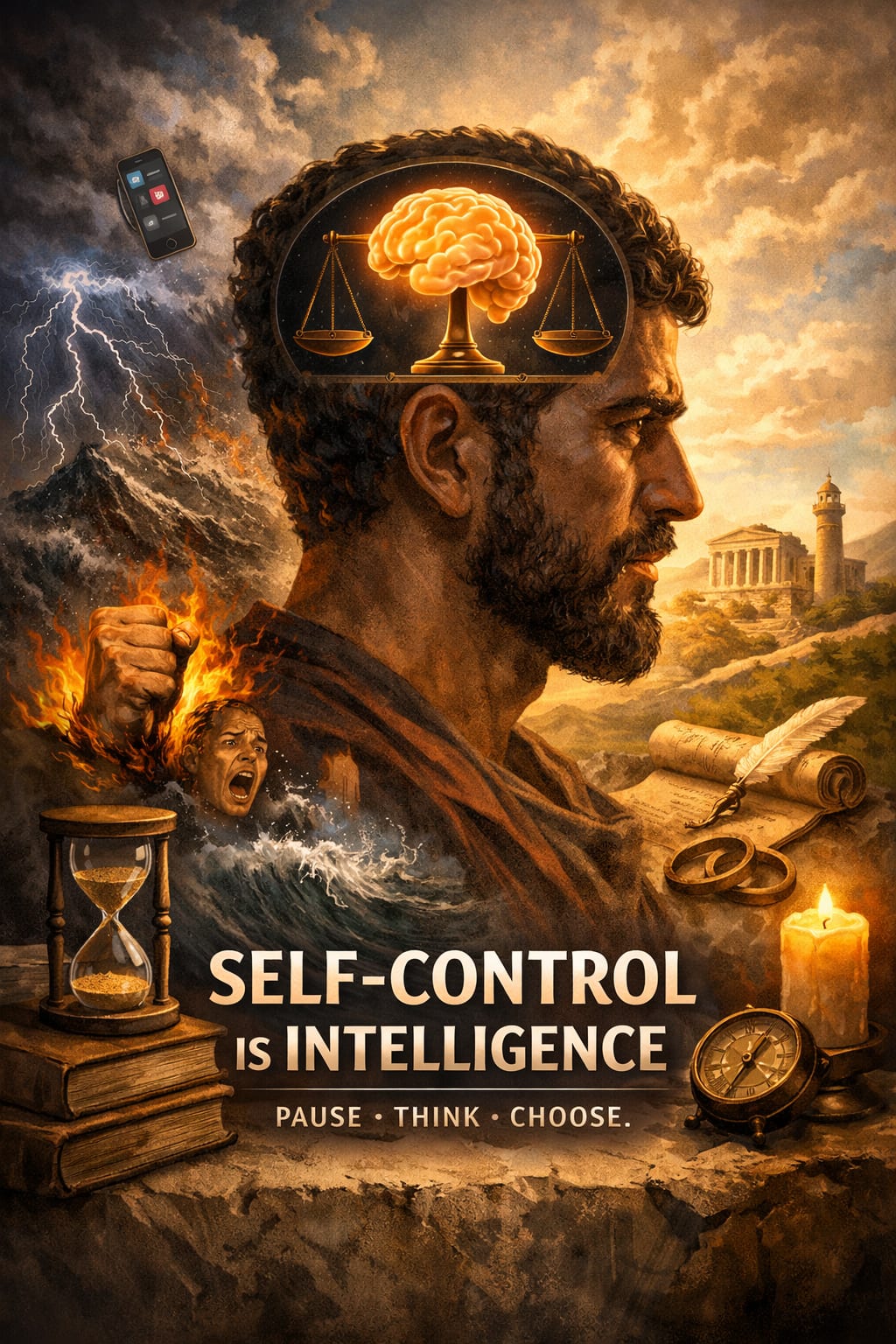
Self-Control Is Not Willpower. It’s Intelligence in Action
Most people think self-control is about white-knuckling your way through temptation. Gritting your teeth. Saying no while sweating bullets.
Stoicism sees it very differently.
To the Stoics, self-control isn’t brute force. It’s intelligence.
And once you see why, the whole idea of discipline changes.
Self-control isn’t suppression. It’s clarity.
The Stoics didn’t believe emotions were enemies. They believed confusion was the enemy.
When you lash out in anger, spiral in anxiety, or chase something you know won’t actually help you, the Stoics didn’t say, “You’re weak.”
They said, “You’re mistaken.”
In their view, destructive emotions aren’t powerful forces overwhelming your reason. They’re bad judgments masquerading as feelings.
Anger says: This shouldn’t be happening.
Fear says: I can’t handle this.
Desire says: I need this to be okay.
Self-control, then, isn’t about shoving those feelings down. It’s about correcting the judgment underneath them. That’s an intellectual act. A thinking act. A smart act.
Intelligence isn’t knowing facts. It’s choosing well.
Stoicism defines intelligence in practical terms: can you make good choices under pressure?
Anyone can sound wise when life is calm. Intelligence shows up when things go sideways—when you’re insulted, stressed, tempted, or scared.
At that moment, you have two options:
- React automatically
- Or pause, assess, and choose deliberately
That pause? That’s intelligence at work.
Self-control is simply the ability to create that gap between stimulus and response—and then use it wisely.
The smartest move is often not reacting.
Here’s the Stoic insight most people miss: reacting emotionally feels powerful, but it’s usually lazy thinking.
Snapping back at someone doesn’t require intelligence.
Panicking doesn’t require intelligence.
Scrolling, overeating, numbing out—none of that requires intelligence.
What does require intelligence is asking:
- Is this actually under my control?
- Does reacting help or hurt?
- What response aligns with who I want to be?
Self-control is the skill of asking those questions in real time.
Emotional discipline saves cognitive energy
The Stoics were ruthless about efficiency.
They believed your mental energy is limited—and wasting it on things you can’t control is like pouring water into a cracked cup.
Getting worked up about other people’s opinions.
Obsessing over outcomes you can’t guarantee.
Replaying insults in your head like a bad movie.
That’s not passion. That’s poor resource management.
Self-control is intelligence because it directs your attention where it actually pays off—your choices, your actions, your character.
Intelligence aims at long-term outcomes, not short-term relief
Impulse feels good now. Wisdom pays off later.
Stoicism trains you to think in longer time horizons:
- How will this choice affect me tomorrow?
- What kind of person does this reaction reinforce?
- Is this pleasure worth the cost?
That ability to delay gratification, to see past the moment, to prioritize future stability over immediate comfort—that’s textbook intelligence.
Not IQ-test intelligence.
Life intelligence.
The bottom line
Stoicism treats self-control as intelligence because it is intelligence.
It’s the ability to:
- See clearly instead of react blindly
- Choose deliberately instead of impulsively
- Act in line with values instead of moods
- Self-control isn’t about being emotionless.
- It’s about being mentally sharp.
And in a world designed to hijack your attention, your impulses, and your reactions, that kind of intelligence isn’t just admirable.
It’s a competitive advantage.